TIME FOR PEACE SERENITY
FRENCH DOCUMENT
I — A JOURNEY WITHIN
In a world of constant movement, noise and uncertainty, Serenity offers something increasingly rare: a moment to reconnect with ourselves. Born from more than forty years of artistic creation and pioneering research into color, light and human perception, Serenity brings together art, science, music and immersive technology to create experiences of contemplation and well-being.
From a few seconds of moving color and music to a twenty-one-minute immersive journey conceived for the hospital environment, Serenity invites us to slow down, to feel, and to rediscover an inner space that the outside world too often makes us forget.
Serenity does not ask us to go somewhere else. It invites us to become present to where we already are.
II — WHAT IS SERENITY ?
Serenity is an evolving artistic and immersive experience created to bring moments of calm, contemplation and inner connection into places where they may be most needed.
Through color, light, movement and music, Serenity creates a slowly transforming visual and sensory environment.
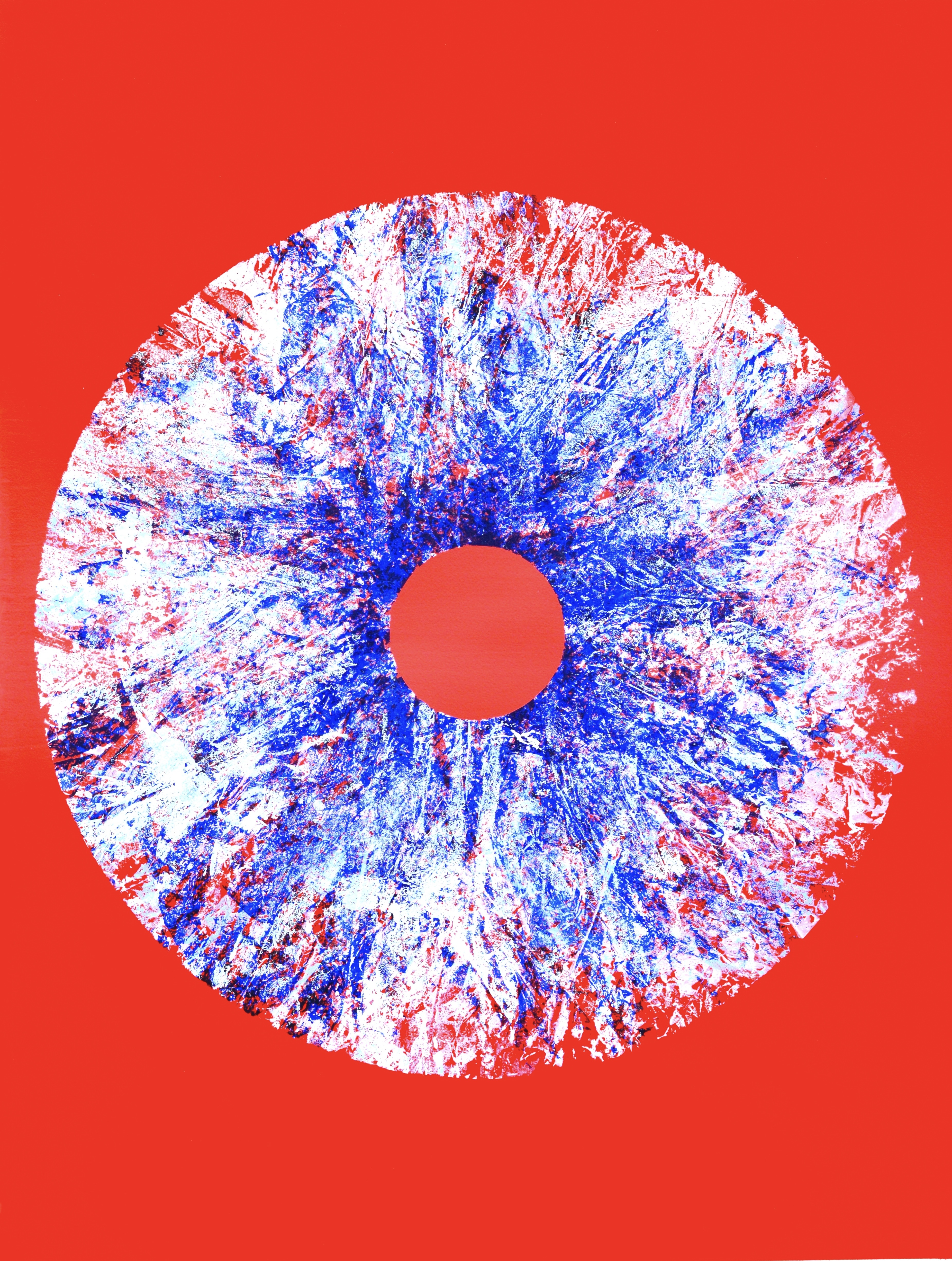
Its visual language begins with the circle — an archaic and universal form found in nature and across civilizations, from the ancient Chinese Bi disc to the halos of Renaissance painting, and later explored by Carl Jung as an image of wholeness and the human relationship to the world around us.
In Serenity, the circle becomes a point of departure, opening in its longer forms toward a wider journey through abstraction, nature, light, movement and sound.
For hospitals, a twenty-one-minute immersive Serenity experience is being developed for patients, including those receiving palliative care, while also offering a moment of respite to families and caregivers.
It is not a medical treatment. It creates another kind of space: a human space.
III — FROM RESEARCH TO SERENITY
The story of Serenity did not begin with virtual reality.
It began more than forty years ago with a question: can color, light and the visual environment influence the way we feel and experience the world around us?
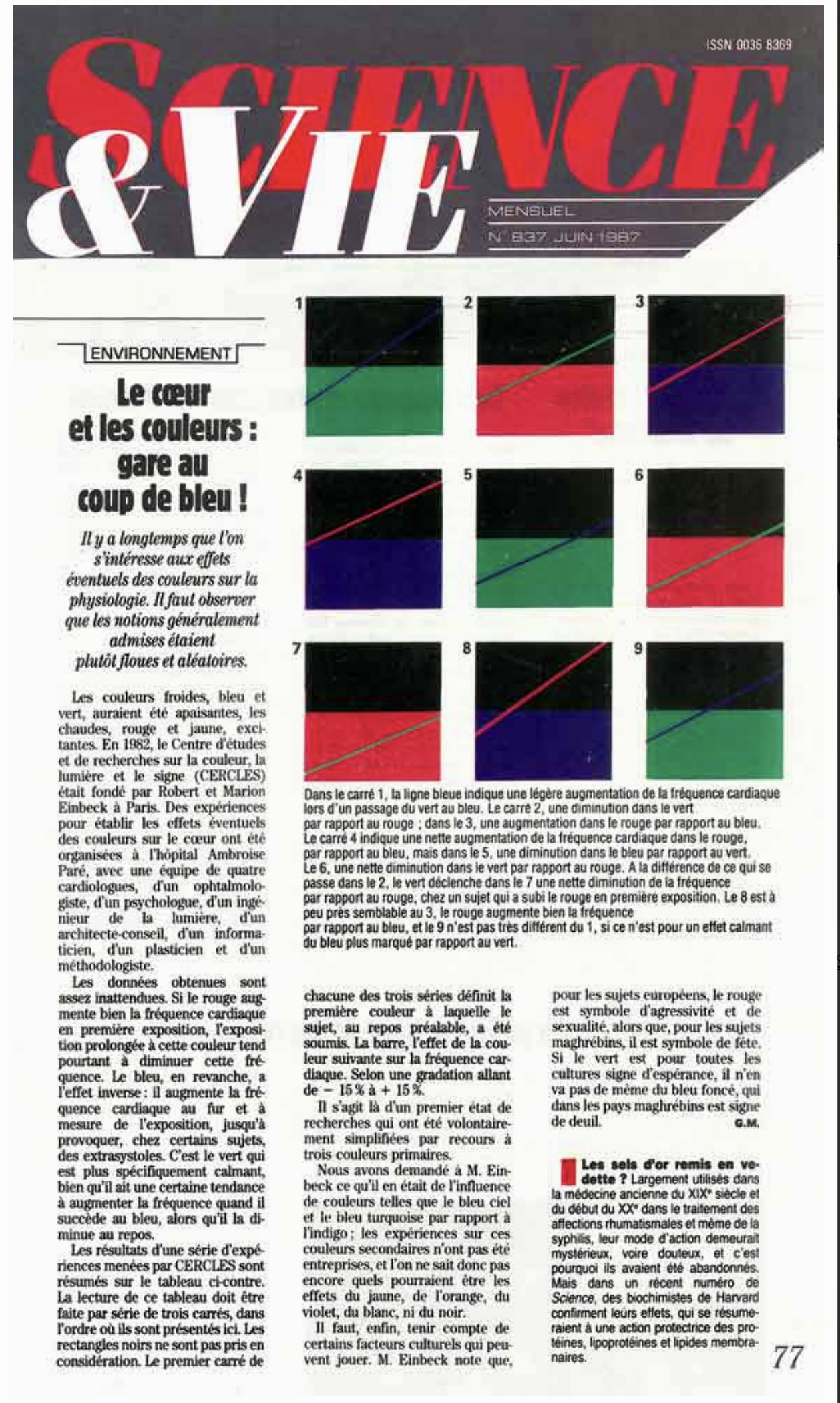
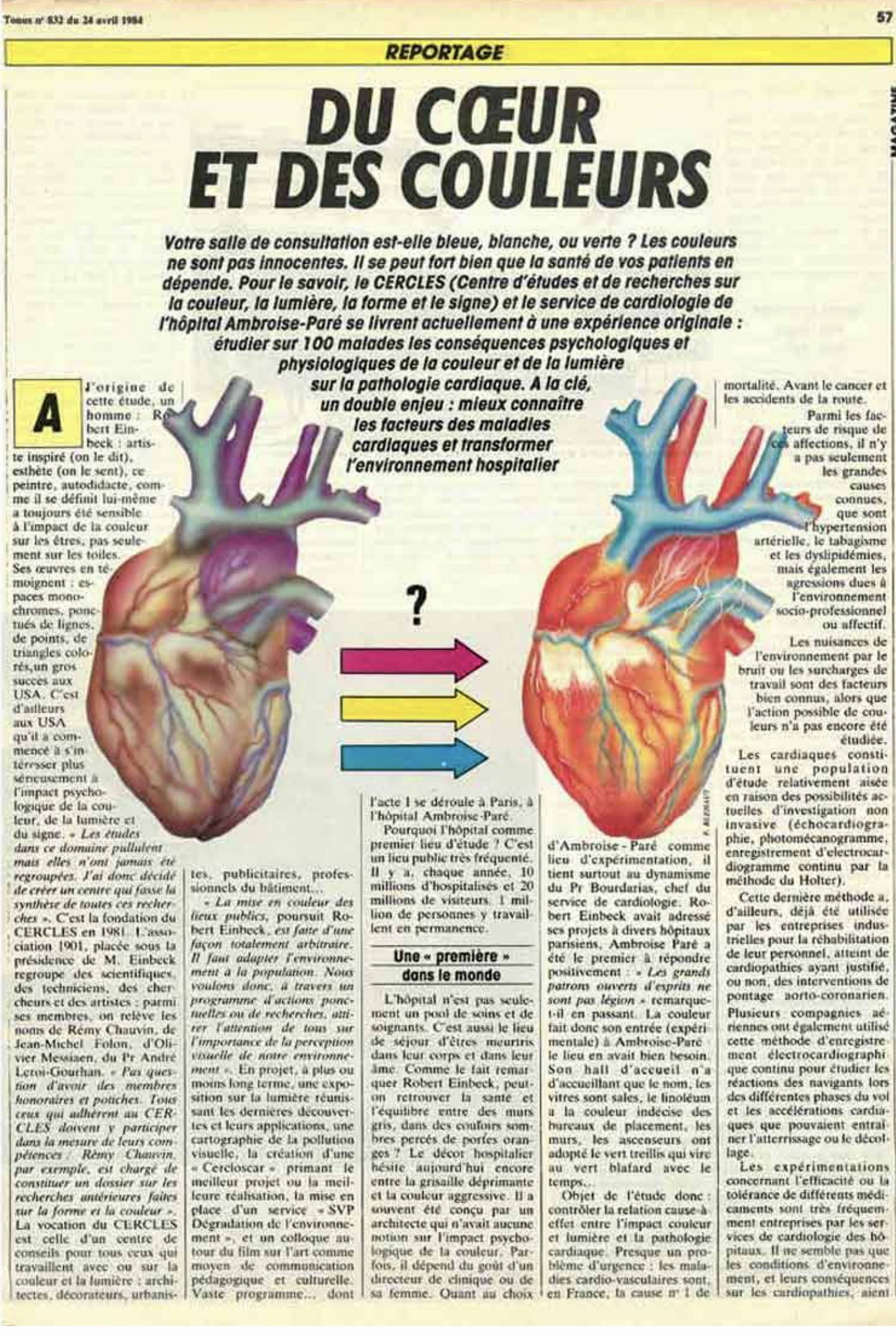
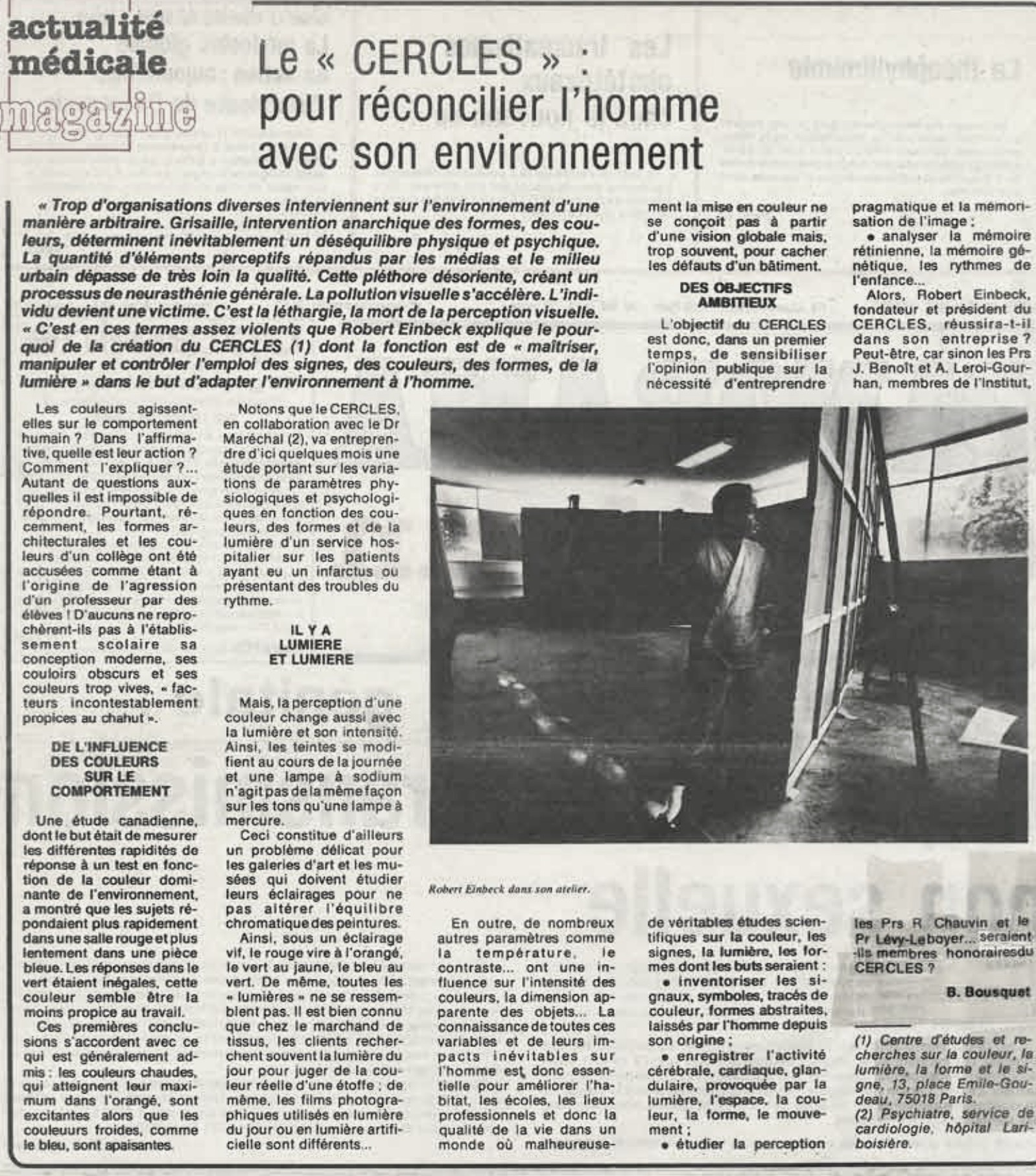
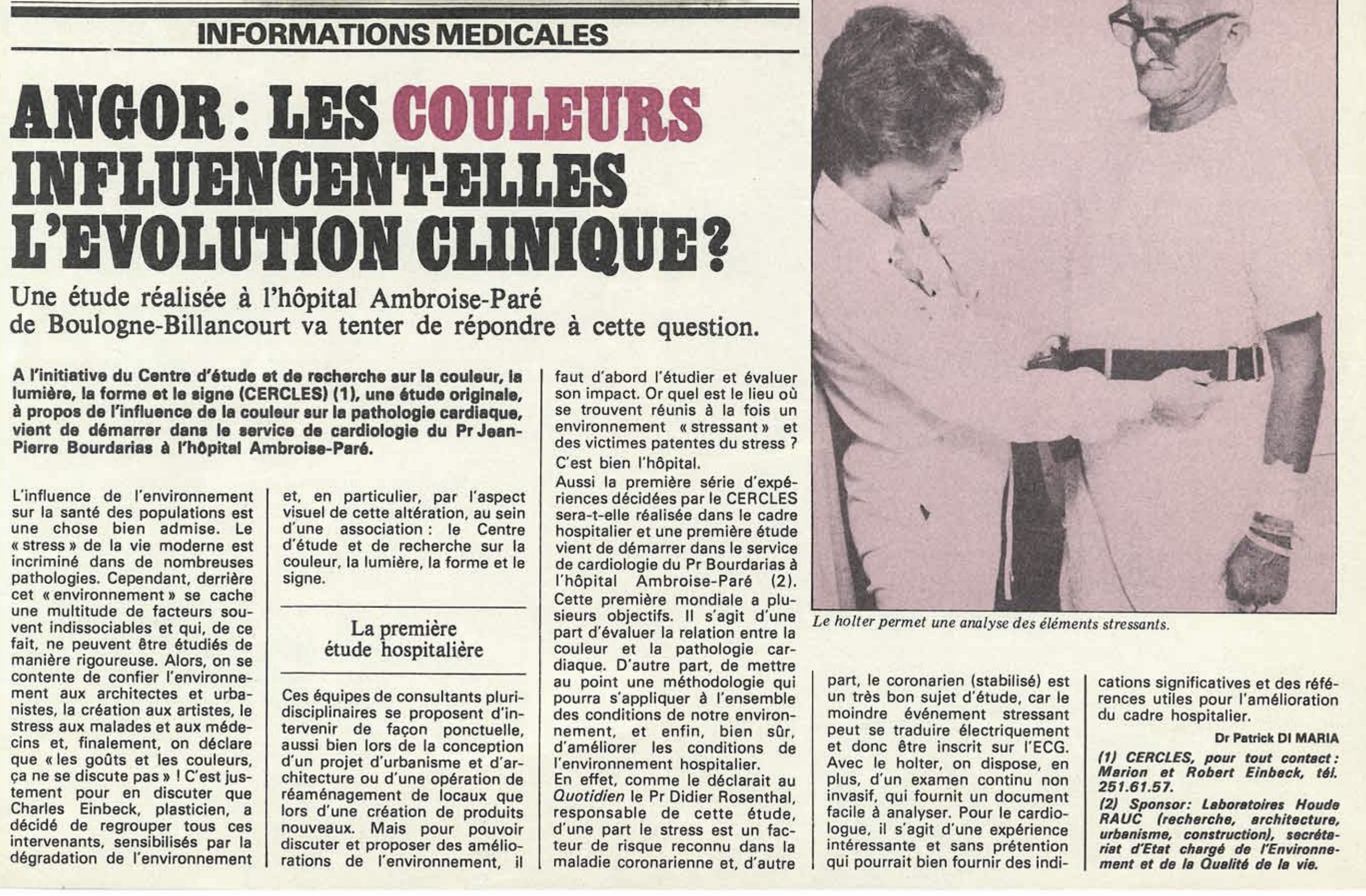
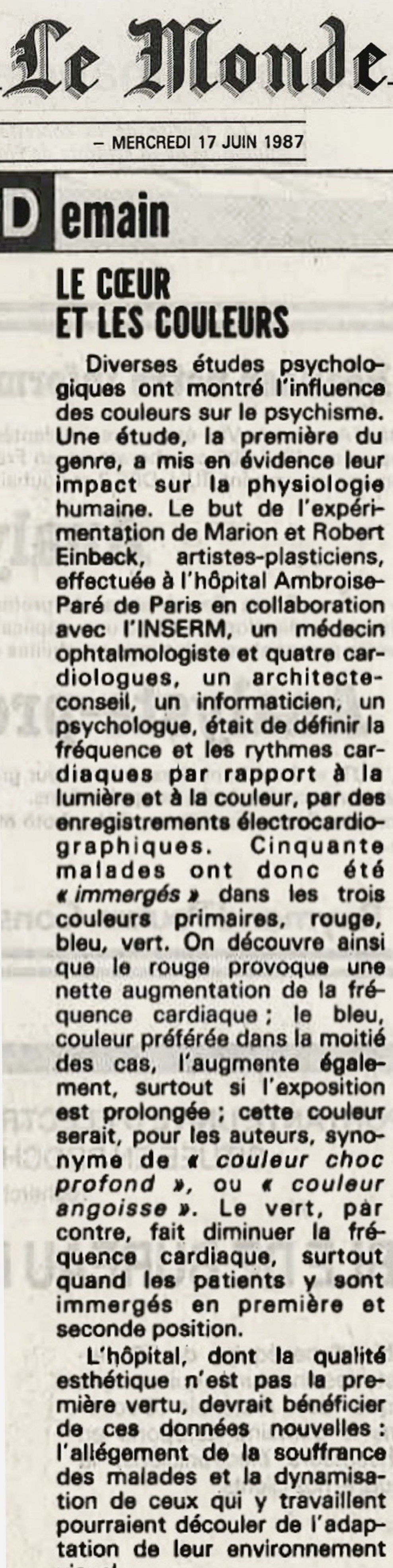
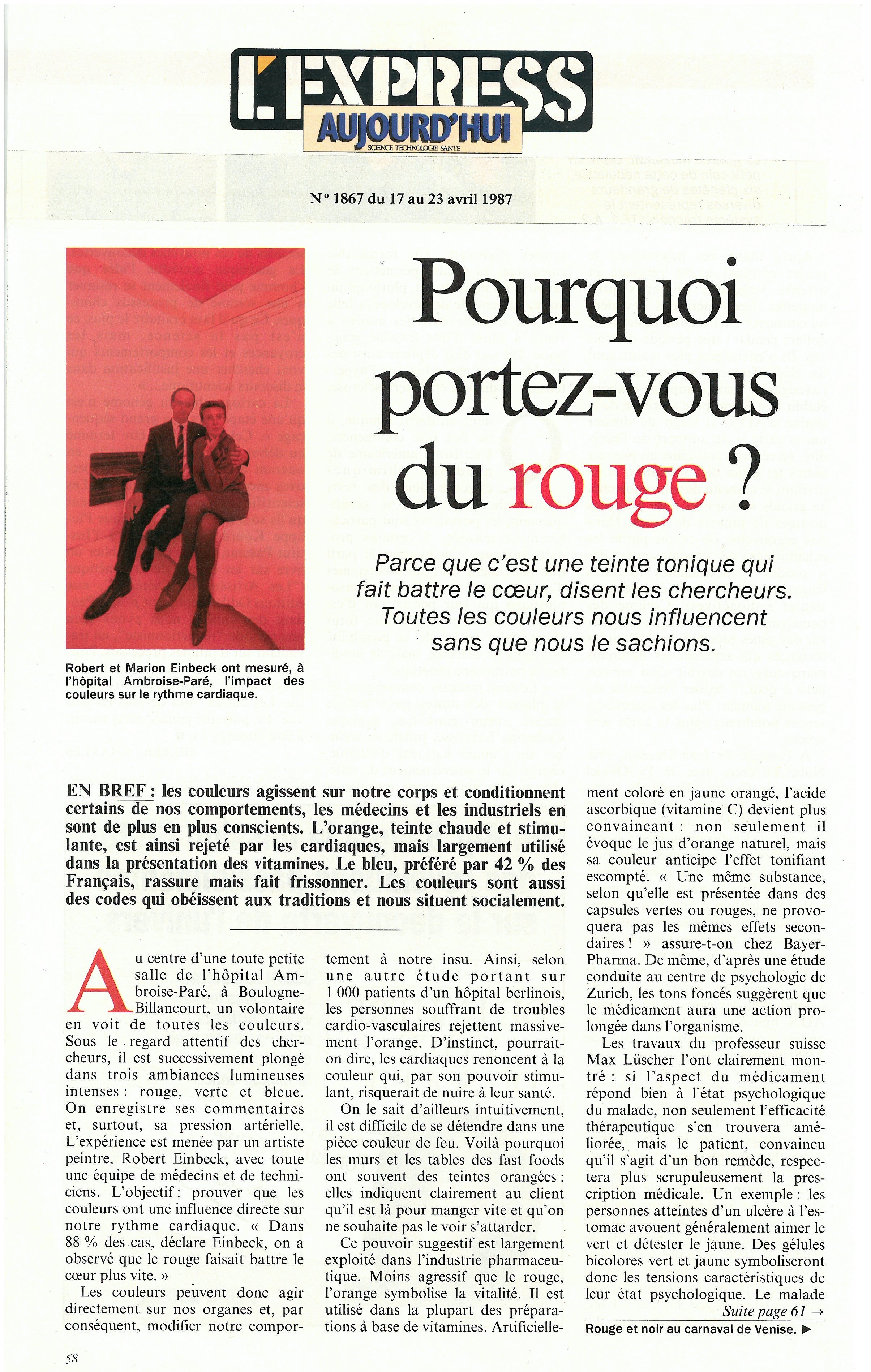
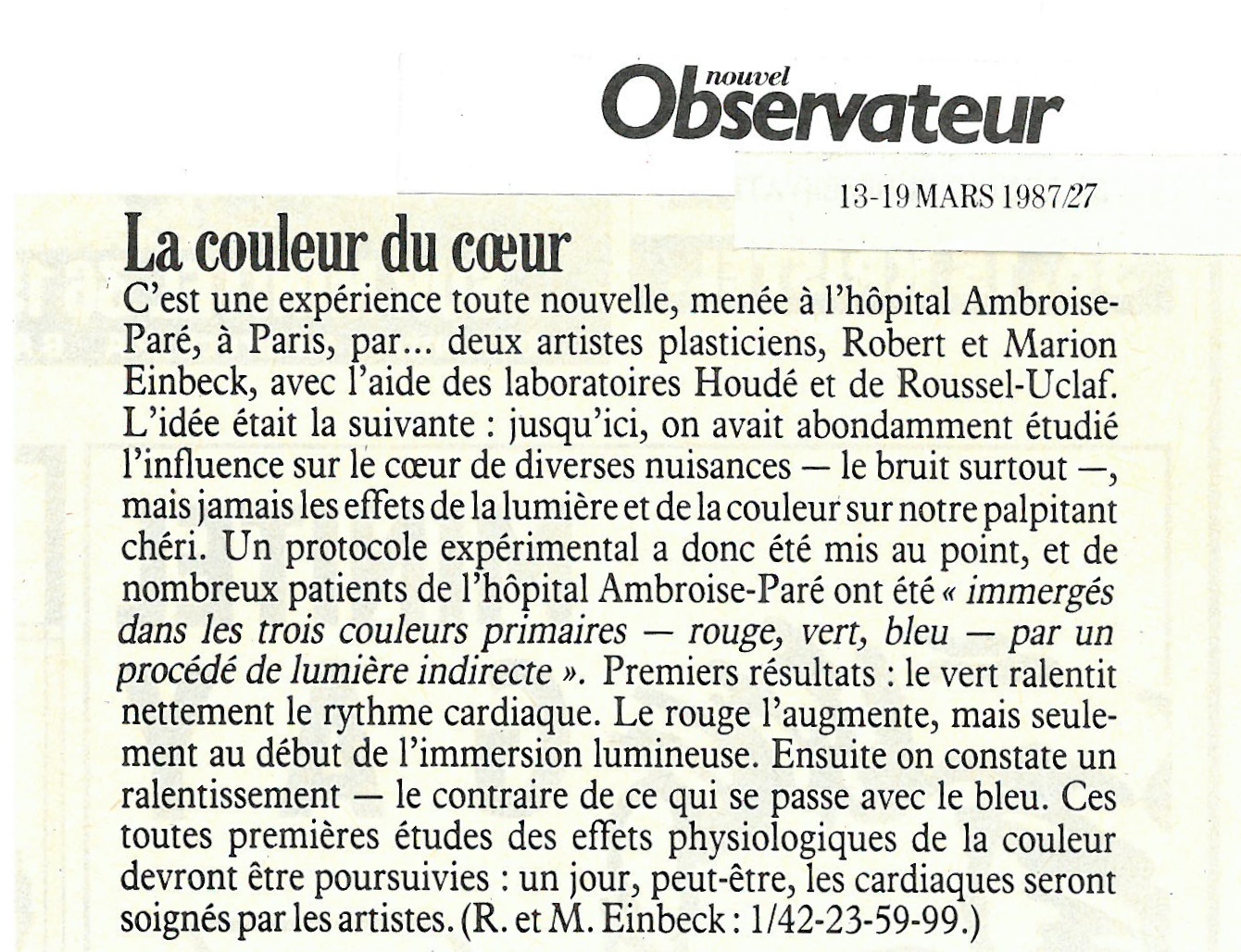
In the early 1980s, Robert Einbeck founded C.E.R.C.L.E.S. — the Centre for Studies and Research on Color, Light and Signs — bringing together researchers from France's CNRS and INSERM, physicians and specialists from different disciplines to explore the relationship between human beings and their visual environment. This inquiry also led to exchanges with researchers in the United States, including at MIT, where Einbeck presented his work and spent time exploring these questions with members of its scientific community.
This research led to an experimental study conducted at Ambroise-Paré Hospital in Boulogne-Billancourt, near Paris with a multidisciplinary medical and scientific team. One hundred volunteer cardiac patients were exposed, under controlled conditions, to different colored environments while physiological and psychological responses were observed and measured.
The findings were subsequently shared with the scientific and medical community, including at the Quinze-Vingts National Ophthalmology Hospital in Paris and at the Accademia Nazionale dei Lincei in Rome, while Einbeck's broader research into color, perception and the human environment also led to presentations and exchanges internationally, including in the United States.
Yet for Robert and Marion Einbeck, the question went beyond measurement. It opened onto a wider reflection: how might art and the environment contribute to creating spaces more attentive to the human being?
Over the following decades, this exploration continued through painting, contemplation spaces, music, film and the Time for Peace project.
Today, immersive technology offers a new way of pursuing that original intuition.
IV — SERENITY TODAY
Today, Serenity is entering a new chapter.
At its heart is a twenty-one-minute immersive experience conceived for the hospital environment — for patients in cardiology and oncology, as well as those receiving palliative care — where image, color, light, movement and music unfold slowly around the viewer.
The experience is not intended to isolate patients from the world, but to offer them another way of inhabiting the moment: a space in which attention can shift, time can feel different, and the mind can momentarily move beyond the immediate reality of the hospital room.
For families and caregivers, Serenity may also offer something simple but essential: a pause.
The experience does not seek to replace medicine, nor does it make a therapeutic promise. It belongs to another dimension of care — one concerned with the environment surrounding the person, with perception, emotion, imagination and the human need for moments of inner quiet.
What began decades ago through color and light can now unfold through immersive technology, allowing the visual world of Serenity to move beyond the surface of an image and gradually surround the person experiencing it.
The technology is new. The intention is not.
Serenity remains what it has always sought to be: a space for the human being within the world.
V — A LANGUAGE THAT CAN TRAVEL
Serenity was never conceived for a single place.
Its language — color, light, movement, music and time — can adapt to different environments and different moments of human life.
It may appear for only a few seconds between two images, unfold for several minutes as an audiovisual experience, or become a longer immersive journey surrounding the viewer.
Over the years, this language has been explored through different forms and contexts: audiovisual creations, cultural environments, travel, hospitality, public spaces and, today, immersive experiences conceived for hospitals.
The setting may change.
The intention remains the same: to create a moment in which the rhythm of the outside world can soften and another quality of attention can emerge.
Serenity can therefore travel.
From one screen to another.
From one place to another.
From one culture to another.
Yet perhaps its most important journey is not geographical.
It is the passage from what surrounds us to what begins to resonate within us.
THREE MINUTES OF SERENITY
VI — BEYOND THE IMAGE
Serenity does not end when the screen becomes dark.
An image may vanish. A sound may fade. Yet something of the experience can remain — a color, a rhythm, an emotion, perhaps simply a different awareness of the moment.
This is where Serenity begins to move beyond the image itself.
Its purpose is not to impose a meaning or to tell us what we should feel. Each person enters the experience with a different history, a different sensitivity, a different inner world.
Serenity creates the space. What happens within that space belongs to each of us.
And as immersive technology opens new possibilities, that space can continue to evolve — beyond the circle, beyond the screen, toward environments in which image, light, movement, music and eventually elements of nature can become part of a continuously unfolding journey.
What surrounds us may then begin to move within us.
VII — FROM VISION TO REALITY
Serenity is not beginning from zero.
Its hospital development has already brought together leading physicians and institutions around a shared ambition: to explore how artistic and immersive environments can contribute to a more human experience of care.
The project was developed in collaboration with Professor Pascal Leprince at Pitié-Salpêtrière Hospital in Paris and Professor Bertrand Marcheix at Toulouse University Hospital, with Professor René Prêtre supporting its development in Switzerland.
Serenity has also received the official support of the French Ministry of Culture and the French Ministry of Health and Solidarity, as well as the support of ADICARE, the association founded by Professor Christian Cabrol, which has contributed to the development of the project at Pitié-Salpêtrière Hospital.
The first twenty-one-minute immersive program is now intended to open a new stage: beginning within the hospital environment at Pitié-Salpêtrière and Toulouse University Hospital, before progressively extending to other hospitals in France and Switzerland, and later to other European countries and the United States.
More than forty years of research and creation have brought Serenity to this point. The next step is to make it accessible.
VIII — THE NEXT JOURNEY
The hospital program is a beginning, not a destination.
Once developed, the Serenity immersive experience can be adapted to other environments where people may benefit from moments of pause, contemplation and reconnection.
Hospitals can lead to new healthcare settings. Healthcare can open toward hospitality, workplaces, fitness and wellbeing environments, airports, universities and selected public spaces.
Serenity can also return to the place from which it first emerged — the world of art — through immersive installations and exhibitions conceived for museums and galleries.
Each environment may require a different duration, format or artistic approach, while preserving the language and intention at the heart of Serenity.
Future research can accompany this development, exploring fields such as perception, stress and sleep, and opening new collaborations with medical and academic institutions.
One language. Different experiences. A world of possible destinations.
IX — BECOME PART OF SERENITY
Serenity is seeking one principal partner to help bring its next chapter to life.
That partnership can go beyond conventional sponsorship.
It may begin by supporting the creation and first deployment of the twenty-one-minute hospital experience, while opening the possibility of a longer-term collaboration around the development and introduction of Serenity into new environments and new countries.
For the right partner, Serenity offers the opportunity not simply to support a project, but to participate in the development of an experience with cultural, human and international potential.
Through Time for Peace, that partnership can also become part of a wider international cultural and editorial journey.
Help bring Serenity where it is needed.
BECOME PART OF SERENITY
X — FROM SERENITY TO TIME FOR PEACE
Serenity began as an artistic and scientific inquiry into color, light, perception and the human environment.
Today, that journey naturally becomes part of Time for Peace.
Since its creation in New York, Time for Peace has explored how cinema, music and the arts can carry humanistic values across cultures and generations. Serenity extends that same conviction into a new field: the experience of our environment and its relationship to the human being.
What began with research and artistic creation can therefore be shared through a wider cultural platform — connecting healthcare, art, science, education and new forms of immersive experience.
The forthcoming Time for Peace Collector Magazine, to be introduced in New York at the end of 2026 / beginning of 2027, will present Serenity as part of this new chapter of Time for Peace, supported by an international public-relations and communications campaign.
Through the Magazine, the Time for Peace Screen Portal and future events and collaborations, Serenity will become part of a broader conversation about art, human experience and the places in which we live.
Serenity was born from a research.
Time for Peace gives it a journey.